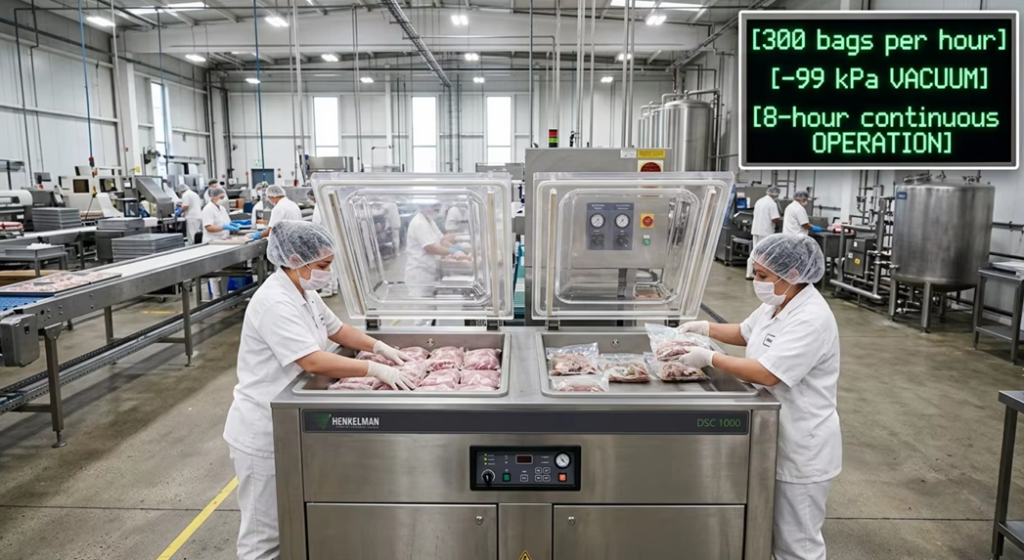
At industrial scale, vacuum packaging is no longer just a preservation tool — it becomes a core production line bottleneck if
the wrong equipment is chosen. For operations running 500+ bags per day with a dedicated packaging team, machine
selection criteria shift fundamentally toward throughput, reliability, and total cost of ownership.
The Ideal User Profile for This Category:
Food processing facility with dedicated packaging line staff
Contract packager or co-packer serving multiple food brands
Frozen food manufacturer (vacuum + freeze, or vacuum + IQF)
Meat processor, poultry plant, or seafood processing facility
Ready-meal or sous vide meal kit production at scale
Why Double-Chamber Is the Baseline at This Scale:
A single-chamber machine operating at 180 bags/hour with one operator produces approximately 1,440 bags per 8-hour shift.
A double-chamber machine with the same operator produces 2,400–2,880 bags — a 67–100% throughput increase at zero
additional labor cost. At 250 working days per year, that difference compounds into hundreds of thousands of additional units
annually.
Industrial-Grade Machine Requirements:
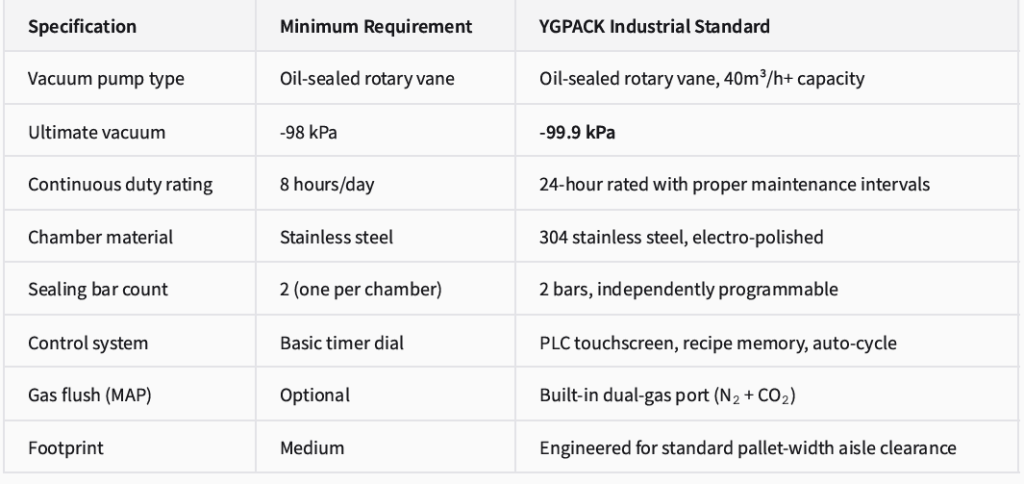
Three Production-Line Configurations by Scale:
Tier 1 — 500 to 1,500 bags/day: Double-chamber machine, single unit, one dedicated operator. Standard oil pump
maintenance schedule. Entry point for industrial-grade production.
Tier 2 — 1,500 to 4,000 bags/day: Two double-chamber machines running in parallel with one supervisor. Staggered
maintenance windows ensure no full production downtime. Consider machines with centralized vacuum pump units for easier
servicing.
Tier 3 — 4,000+ bags/day: Transition to rotary (carousel) vacuum packaging machines or thermoform-fill-seal lines, which
eliminate manual loading entirely. YGPACK offers configuration consulting for facilities at this scale.
Critical Procurement Checklist for Industrial Buyers:
- Request factory acceptance test (FAT) documentation showing pump vacuum at -99 kPa
- Confirm IP rating of control panel (minimum IP54 for wet food environments)
- Verify CE / FDA / local food-contact certification on all chamber-contact surfaces
- Confirm lead time on replacement pump vanes and seal bar heating elements
- Negotiate a preventive maintenance contract before the first year of operation