This is the most commonly misunderstood distinction in vacuum packaging. “Internal vacuum” and “external vacuum” refer
to where the bag is positioned relative to the vacuum pump — and it has major consequences for what products you can
package and what vacuum level you can achieve.
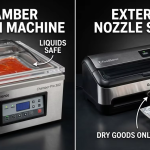
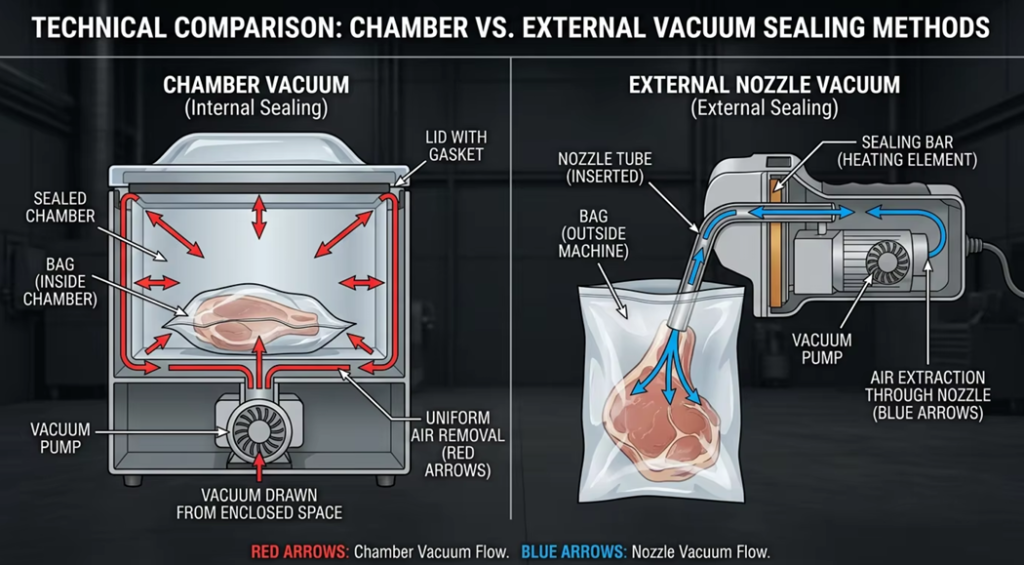
Internal Vacuum (Chamber Vacuum Machine): The bag is placed entirely inside a sealed chamber. When the pump runs, it
evacuates the whole chamber — the bag exterior and interior reach the same pressure simultaneously. Because there is no
pressure differential across the bag walls during evacuation, the bag cannot be “crushed” or distorted. This means:
Liquid products can be safely packaged (no liquid boiling/splashing from pressure differential)
Soft, crushable products (bread, chips, pastries) retain their shape
Very high vacuum levels (up to -99 kPa) are achievable
Thinner, cheaper bag films can be used (no need for extra structural rigidity)
External Vacuum (Nozzle/External Vacuum Sealer): The bag remains outside the machine. A nozzle or suction channel inserts
into the bag opening and pulls air out from inside the bag only, while the bag exterior remains at atmospheric pressure. This
creates a pressure differential across the bag walls — atmospheric pressure (101 kPa) on the outside, near-vacuum on the
inside. This means:
Maximum achievable vacuum is limited by bag film strength (typically -60 to -75 kPa)
Liquid products will boil, foam, and be sucked into the pump — not suitable
Ideal for firm, dry products that won’t be deformed by external pressure